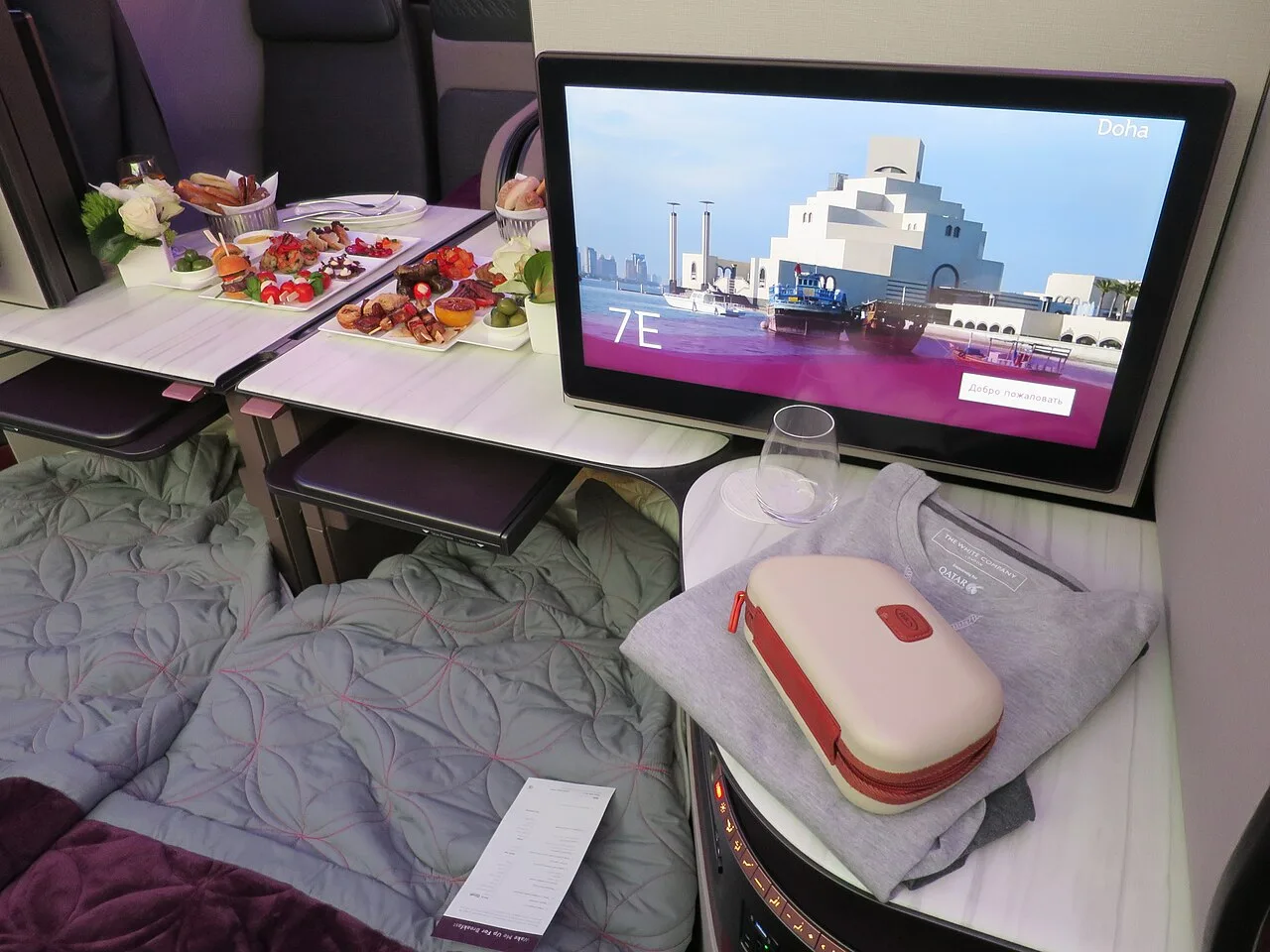
The Seat and Suite Gap Has Narrowed
A decade ago the gap between business and first class was obvious: business meant a recliner or angled-flat seat, first meant a genuine flat bed with real square footage. That's flipped. Nearly every full-service airline now flies fully flat business class seats with direct aisle access, and the best of them — Qatar's Qsuite, Singapore Airlines' business class, Cathay Pacific's Aria seat, Delta One Suite — come with closing doors, making them feel more like a private suite than a traditional airplane seat.
A decade ago the gap between business and first class was obvious: business meant a recliner or angled-flat seat, first meant a genuine flat bed with real square footage. That's flipped. Nearly every full-service airline now flies fully flat business class seats with direct aisle access, and the best of them — Qatar's Qsuite, Singapore Airlines' business class, Cathay Pacific's Aria seat, Delta One Suite — come with closing doors, making them feel more like a private suite than a traditional airplane seat.
What first class still adds, where it exists, is raw space. Emirates and Etihad first suites are essentially small private rooms with a separate ottoman for guests and a full-size wardrobe. Singapore Airlines and Lufthansa first class seats are noticeably wider than their business seats and often positioned in a small standalone cabin, which itself creates a sense of exclusivity no business cabin can match.
First Class Is Increasingly Rare
This is the part travelers get wrong most often: assuming every airline still has a first class cabin on long-haul widebodies. They don't. Delta, United, and American have all eliminated international first class, rebranding their best product as business class and pricing accordingly. Air France, British Airways, and several other legacy European carriers have also cut first class back to a handful of aircraft or dropped it entirely on most of the fleet.
This is the part travelers get wrong most often: assuming every airline still has a first class cabin on long-haul widebodies. They don't. Delta, United, and American have all eliminated international first class, rebranding their best product as business class and pricing accordingly. Air France, British Airways, and several other legacy European carriers have also cut first class back to a handful of aircraft or dropped it entirely on most of the fleet.
The airlines still investing meaningfully in first class are a short list: Emirates, Etihad, Singapore Airlines, Lufthansa, Japan Airlines, ANA, and Qatar Airways on select routes. Even among these, first class is usually limited to specific aircraft types and routes, so you often have to search deliberately — or use miles — to find it at all.
Ground Experience: Where First Class Still Earns Its Keep
If there's one area where first class remains unambiguously better, it's everything that happens before you board. Airlines that still sell first class often pair it with dedicated check-in counters, expedited immigration where available, standalone first class lounges, and chauffeur or car service to and from the airport.
If there's one area where first class remains unambiguously better, it's everything that happens before you board. Airlines that still sell first class often pair it with dedicated check-in counters, expedited immigration where available, standalone first class lounges, and chauffeur or car service to and from the airport.
Business class passengers usually get lounge access too, but it's typically the shared business lounge rather than a first-only space, and chauffeur service is either unavailable or reserved for the airline's top elite tier. This ground experience is arguably the biggest differentiator between the two cabins today, more than the seat itself.
Is the First Class Premium Worth It?
First class fares — and even award redemptions — often cost significantly more than business for a seat that gets you there at the same time. If you're paying cash, the jump usually isn't worth it unless the ground experience genuinely matters to you: a long layover spent in a standalone lounge, a milestone trip, or a route where the suite is a real step up, like Emirates or Etihad first.
First class fares — and even award redemptions — often cost significantly more than business for a seat that gets you there at the same time. If you're paying cash, the jump usually isn't worth it unless the ground experience genuinely matters to you: a long layover spent in a standalone lounge, a milestone trip, or a route where the suite is a real step up, like Emirates or Etihad first.
Where first class becomes an easier call is with miles and points, since many loyalty programs price first class awards at a smaller premium over business than cash fares suggest. If you're booking with points and seats are available, it's worth comparing both cabins before assuming business is automatically the smarter choice.
Watch Out for Naming Confusion
Airline marketing muddies this further. Qatar Airways calls its best seat 'Qsuite' and it's a business class product, not first, despite feeling first-class in privacy. Delta One, United Polaris, and American Flagship Business are all business class despite premium-sounding names.
Airline marketing muddies this further. Qatar Airways calls its best seat 'Qsuite' and it's a business class product, not first, despite feeling first-class in privacy. Delta One, United Polaris, and American Flagship Business are all business class despite premium-sounding names.
The safest approach is to ignore the marketing name and check the actual seat map and cabin details — width, whether doors close, whether it's a true suite — before booking, since 'first class' and 'business class' mean very different things depending on the airline.